The $2,249.99 P320 kit leaves out the registered part
A current Canadian P320 kit includes the slide, barrel, grip module, and an empty trigger guard. The omitted FCU explains what Canada registers.

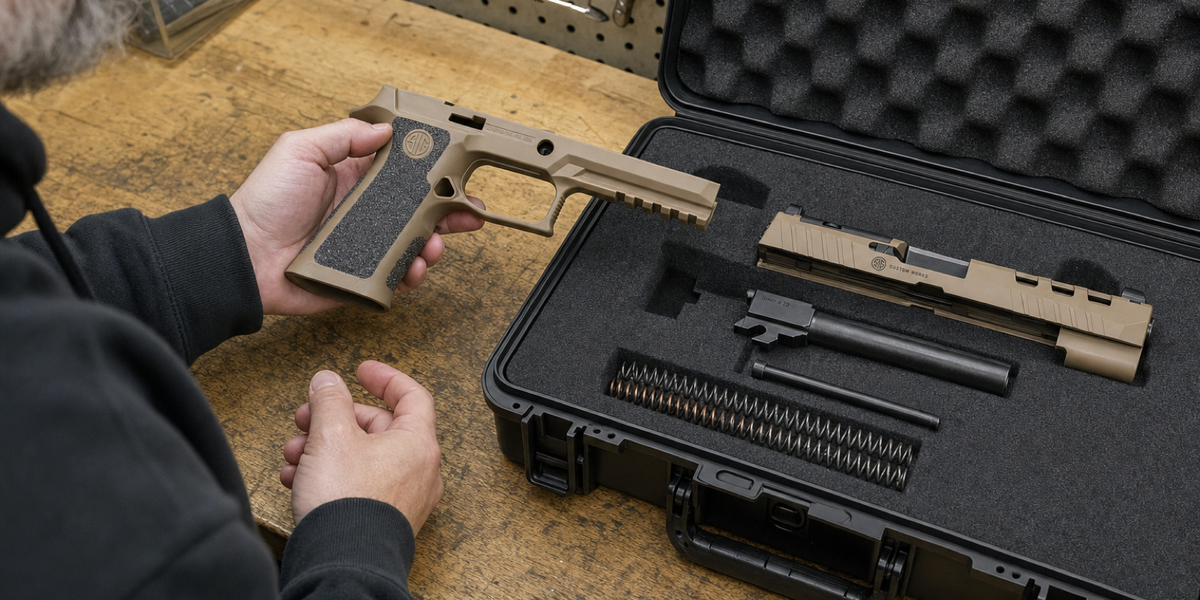
The tan P320 in the product photograph has a slide, barrel, sights, grip, and empty trigger guard. The small part that would put a trigger there is also the part Canada registers.
RDSC currently lists the SIG Sauer P320 XFIVE DH3 Caliber X-CHANGE Conversion Kit at CA$2,249.99. Its first warning is more important than the price: the fire-control unit, or FCU, is not included.
Holdover produced the feature as a fictional parts inspection using current Canadian retailer reference views. The owner, workshop, parts, and session do not depict RDSC inventory or a documented purchase.
The clue sits inside the trigger guard
A new Canadian shooter looking at the main product photo could reasonably call it a handgun. The slide is sitting over the coyote-tan grip module. The barrel, sights, takedown lever, controls, and magazine well all occupy familiar places.
Then the eye reaches the trigger guard. It is empty.
When I first opened the current listing, I registered the tan slide and grip as a complete pistol. The empty trigger guard corrected me. That small pause is why this parts kit is worth explaining.
RDSC's separated-parts photograph makes the architecture clearer. The package shows the slide, 5-inch barrel, guide rod, two recoil springs, heavy XFULL grip module, and magazines. The steel chassis that would carry the trigger and support the slide is absent.
That missing assembly is the P320's legal and mechanical centre.
SIG Sauer defines the FCU as the assembly that houses the trigger, sear, and slide catch. In the P320 and P365, the manufacturer says, the FCU is the serialized frame. It can be removed and moved among compatible grip modules, barrels, and slides.
The outer grip can therefore change colour, texture, weight, and size while the serialized part remains the same small internal chassis. The DH3 kit sells a new competition configuration around that chassis. It does not supply the chassis itself.
Canada registers the basic part
The federal registration language follows the same basic logic.
The RCMP information sheet for an application to register firearms describes a frame or receiver as the basic part to which the stock, barrel, magazine, and other parts are assembled. It also states that a frame or receiver alone cannot discharge a projectile. That incomplete state still belongs in the registration section.
The RCMP document is general. It does not name the P320. SIG supplies the model-specific connection by identifying the removable FCU as the P320 frame. Put the two sources together and the current listing stops looking strange: the big tan parts create the silhouette, while the absent steel FCU carries the serial number and registration identity.
Canada's current handgun freeze raises the stakes around that distinction. Section 12.2 of the Firearms Act says a registration certificate for a handgun must not be issued to an individual. Separate sections set out limited exceptions. This product page does not decide whether a shopper meets one of them.
The direct answer to the community question is narrower. The listing is not offering a new serialized P320 frame. It is offering parts that require an existing compatible FCU before they can become an operable P320.
What CA$2,249.99 changes
The price makes more sense when read as a complete competition configuration. RDSC identifies the DH3 package as a Custom Works system developed with Daniel Horner. The listing names an optic-ready slide, suppressor-height sights, a 5-inch match-grade bull barrel, a one-piece guide rod, two recoil springs, and a tungsten-infused XFULL grip module finished with silicon-carbide texture.
Those parts change most of what the shooter touches and sees. The slide and barrel set the upper geometry. The grip module changes the weight, texture, and fit in the hand. The springs let a qualified owner tune the configuration within the manufacturer's intended system.
The FCU remains the bridge through all of it. Without one, the grip module has no trigger group and the upper has no serialized frame to ride on. The package can fill a large case and carry a larger receipt while remaining mechanically unfinished.
That is the modular P320 bargain in its clearest form. One registered chassis can support materially different configurations. Each configuration can also cost enough to resemble a second pistol purchase.
Read the FCU line first
The useful habit is simple. When a Canadian listing calls a P320 product a conversion kit, X-CHANGE kit, grip module, or complete upper, find the FCU line before reading the marketing copy.
Then make three checks:
- Identify the serialized component. For the P320, SIG says that component is the removable FCU, not the outer grip module.
- Read the included-parts list. Confirm the exact slide, barrel, springs, grip size, sights, and compatibility. One P320 kit does not define every other P320 kit.
- Confirm the Canadian record before changing configuration. The Canadian Firearms Program, the registration certificate, the manufacturer manual, and a competent dealer or gunsmith are the right sources for a specific owner's legal and mechanical questions.
This is a reading method, not an installation guide. A four-figure parts kit deserves the same source discipline as the firearm it will eventually surround.
The small part carries the consequence
The current RDSC page is unusually honest visual education. One photograph shows almost the whole pistol silhouette. The empty trigger guard gives away the missing system. The separated view confirms where the money went.
For an existing P320 owner, the kit can change the shooting configuration without creating another serialized FCU. For a reader who lacks that compatible registered chassis, it remains an expensive set of parts.
Look at the trigger guard first. It tells you what CA$2,249.99 cannot buy.
Shortlist the rifle before the checkout page.
If this piece helped you narrow the rifle question, keep the tradeoffs visible before the next tab becomes a shopping cart.
Use the Holdover Rifle Cartridge Shortlist Card to compare use case, distance, recoil, ammunition availability, rifle fit, optics plan, budget, and what you will actually practice.
Safety note: the card is a planning worksheet, not buying advice, legal advice, hunting guidance, load data, or a substitute for current manufacturer, range, provincial, federal, or qualified-instructor guidance.