Tumbler Ridge: *facts* worth agreeing on
A renewed request for Tumbler Ridge firearm details gives licensed owners reason to support a staged, verified account of acquisition and access.

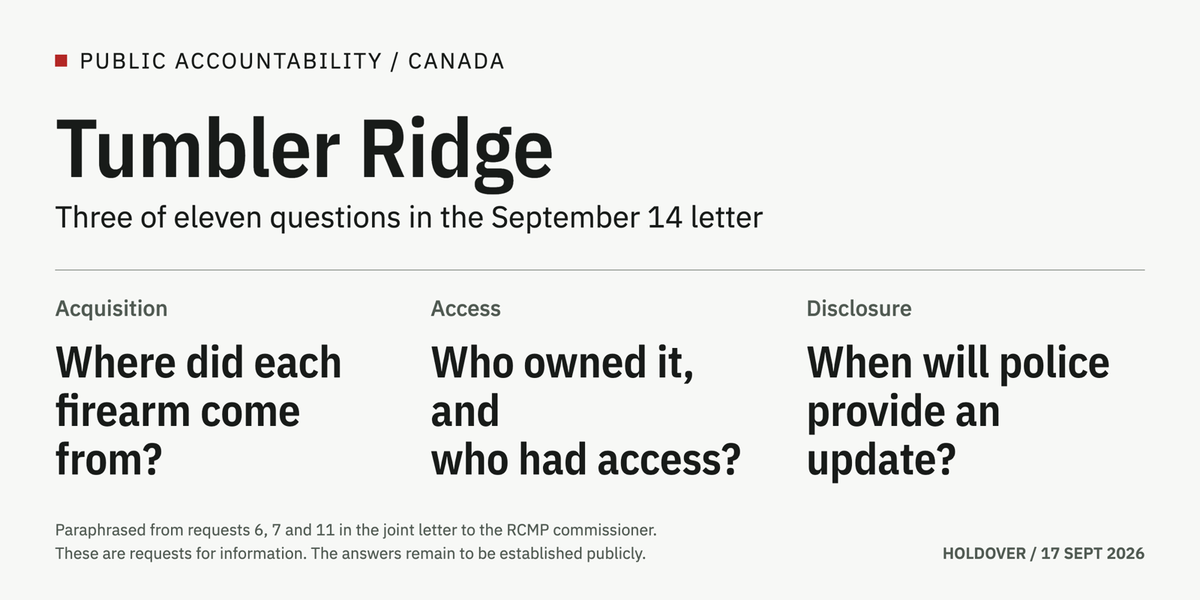
Licensed firearms owners should support the request for a fuller account of how the Tumbler Ridge shooter obtained access to firearms. That account could expose a failure that demands action. It could also help Canadians judge whether a proposed restriction would have changed what happened. Both possibilities deserve an honest hearing.
On September 16, The Canadian Press reported that five gun-control advocacy groups had renewed their request for firearm details from the RCMP. Police told the news agency that the investigation remained active and that they could not discuss specific details or investigative actions. The groups' September 14 letter asks for information that investigators can release without compromising their work, and a timetable for further disclosure.
I read firearms rules because they affect my own purchases and range time. When someone proposes another restriction on licensed owners, I want to understand the connection between that restriction and the harm it is supposed to prevent. The families and community affected by Tumbler Ridge deserve the same care with evidence, for reasons far greater than anyone's next purchase.
The questions owners should support
The letter's signatories include PolySeSouvient, an organization whose broader policy approach Holdover opposes. On this request, there is useful ground for agreement. Canadians should have enough verified information to assess how someone gained access to the firearms used in the killings.
Among its eleven requests, the letter asks where each firearm came from, who owned it, and who could access it. It seeks the history of any seizure or return, along with information about storage and supervision. The final item asks police to explain which categories of information they must withhold and when they expect to provide an update.
Those questions require evidence. Their inclusion in a letter establishes what the signatories want investigators to address; the answers will determine which conclusions hold up.
Acquisition and access deserve particular attention. A person can acquire an item through one route and someone else can gain access through another. A useful public account would trace both stages, as far as the evidence permits. Otherwise, readers may fill the missing steps with whichever explanation they already favour.
For owners, the temptation will be to look for facts that vindicate our position. We should expect to read findings that challenge it, too. If investigators establish an avoidable failure by an owner, those facts belong in the account. The same standard should apply to decisions by public officials. A serious defence of responsible ownership includes a willingness to examine conduct within our own community.
Read the RCMP statements with their dates
The RCMP's February 13 update contains a detail that needs careful handling. Police said the main firearm believed to have been used at the school had never previously been seized by the RCMP, and that its origin was unknown at that point. The timing and qualification matter. That statement describes investigators' position in February.
Readers should preserve that distinction when discussing firearms removed from or returned to a household. Connecting a particular firearm to a particular police decision requires evidence about that firearm. A broad account of household contact can leave a reader with a false impression about which weapon followed which path.
On July 7, the RCMP said investigators were completing firearms assessments and that charges remained possible. Police also explained that investigators may possess information they have withheld from the public to protect the investigation and a potential prosecution. The September Canadian Press report carried a renewed statement that the investigation was ongoing.
Police have a substantial reason for caution. A premature release can affect people whose conduct remains under investigation, and public pressure cannot settle the consequences of releasing a particular fact. From outside the investigation, I cannot assess each withheld detail. RCMP leadership should explain the limits of disclosure as clearly as the work allows.
The public can hold that position while asking police to revisit those limits. Information suitable for release may change as investigators finish specific tasks. A dated explanation would help readers understand the next step and judge whether the force follows through.
Judge the next update by what it explains
I would read the next official account with one question in mind: does it explain how the firearms became accessible to the person who used them? A model name or classification would answer part of the public's request. Assessing prevention also requires the sequence of decisions and events that led to access.
For any proposed response, officials and advocates should identify the point in that sequence they intend to change. They should explain who would have acted differently, what information that person would have needed, and how the proposed measure would have affected the outcome. Those are demanding questions. They are appropriate when asking Canadians to accept new obligations or restrictions.
Licensed owners have a practical stake in that standard. A new obligation can mean another condition to understand and comply with each time we handle our own firearms. Its proponents should explain the expected benefit with enough precision for an owner, a police officer, or a victim's family to assess it. We can insist on that explanation while supporting measures that the evidence justifies.
The RCMP can help by separating established findings from unresolved questions in its next update, dating the account, and committing to a further disclosure review. Even a review that results in continued withholding should give the public the clearest explanation the investigation permits.
Tumbler Ridge families have waited through months of investigation. I support the request for a staged public account, with room for police to protect a prosecution and a clear expectation that they will explain more as that protection allows. Owners should read the eventual findings with the same care we ask policymakers to bring to decisions about us.
Sources
- The Canadian Press, September 16: renewed requests for Tumbler Ridge firearm disclosure
- September 14 letter to the RCMP commissioner, published by PolySeSouvient (PDF)
- RCMP, February 13: investigative update on the Tumbler Ridge shooting
- RCMP, July 7: statement on the Tumbler Ridge criminal investigation
The amnesty file is still moving.
If this piece sent you back to government pages, do not wait for the next portal, Gazette, or court move to find you by accident.
The Dispatch follows Public Safety, RCMP, Canada Gazette, court, compensation, collection, and amnesty updates so the next change comes with the source that moved.
Safety note: the tracker is a worksheet for source hygiene, not legal advice or a substitute for current official guidance.