What You Gain - and Give Up - With an Ultralight Rifle
A four-pound hunting rifle is easier to carry. An eight-pound rifle is easier to shoot. Neither is automatically better - and knowing which problem you actually need to solve matters more than the number on the scale.

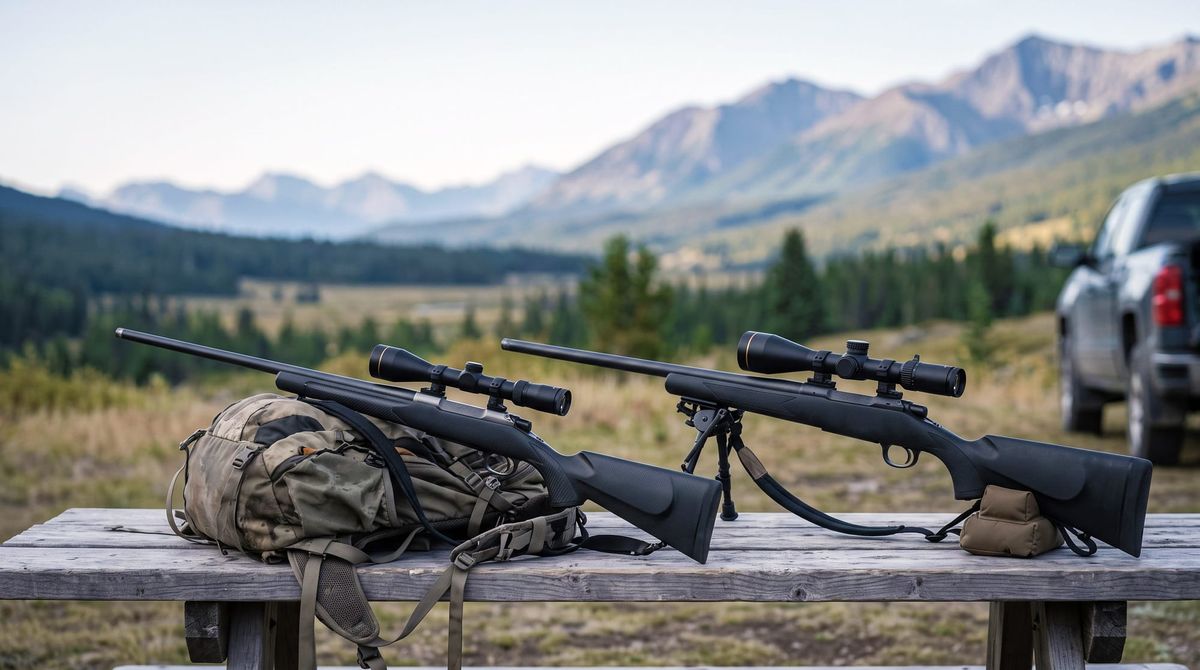
Outdoor Canada's 2026 rifle list opens with the Weatherby Mark V Backcountry Capra, which senior field editor Ken Bailey describes as weighing between 4.1 pounds in short action and 4.4 in long, and "may well be the lightest-ever production centrefire rifle." Six entries later, the same list recommends Ruger's Generation II Prairie, whose selling points include "a bull contour to add stability and reduce recoil."
Twelve rifles, one list, and two directly opposed answers to the same question. Both answers are correct. They are correct for different people, and the fall buying season now underway across this country will be decided largely by how many Canadians know which of those people they are.
What the weight actually changes
Free recoil energy is arithmetic. It rises with bullet weight, powder charge and muzzle velocity, and it falls with rifle weight. There is no ambiguity in it and no marketing in it.
Take a 4.1-pound short action, add a modest scope, rings, sling and a full magazine, and call the shooting weight 5.5 pounds. Compare that against a conventionally stocked scoped hunting rifle at 8.5 pounds. Same cartridge, same load, same shooter.
| Load | 5.5 lb ready | 8.5 lb ready |
|---|---|---|
| 6.5 Creedmoor, 143 gr at 2,700 fps | 19.4 ft-lb | 12.5 ft-lb |
| .308 Win, 165 gr at 2,700 fps | 24.6 ft-lb | 15.9 ft-lb |
| .300 Win Mag, 180 gr at 2,960 fps | 47.9 ft-lb | 31.0 ft-lb |
Across every one of those loads the lighter rifle delivers 1.55 times the free recoil energy, because the ratio depends only on the two rifle weights. The .300 Win Mag figure is the one worth sitting with. Forty-eight foot-pounds is heavier than a 12-gauge slug gun, arriving at 23.7 feet per second of rearward velocity, into a shoulder that has not been trained for it.
Recoil velocity is the number that produces flinch, and flinch is what actually ruins shots. A shooter who has developed one will pull a rifle off a deer at eighty metres regardless of what the rifle cost.
Weatherby already told you
The most honest evidence about a light rifle's recoil comes from the people who built it.
Weatherby's own pages for the Capra list a 3D hex recoil pad with a honeycomb structure to "crush felt recoil," a modified Peak 44 Blacktooth stock chosen partly for "effective recoil control," a TriggerTech trigger to help shooters hold form, and a barrel threaded 1/2x28 with an Accubrake ST included in the box. That is four separate countermeasures shipped as standard on one rifle.
Manufacturers do not spend money solving problems their product does not have. Read that feature list as a specification sheet and it tells you plainly what four pounds costs, and how seriously the engineers took it.
The thin double-spiral fluted barrel carries a second cost that no pad addresses. Less steel means less thermal mass, so a light barrel heats faster and walks its point of impact sooner. On a mountain hunt where three rounds is a long day, that is irrelevant. At a Canadian club range in September, confirming a zero across ten or fifteen rounds before the season, it is the difference between data you can trust and a group you have to explain.
Every centrefire rifle in my own safe is either a chassis gun or a magnum, and not one of them was bought to save weight. That is a bias, and it comes from shooting almost entirely from bipods and bags rather than from the side of a mountain. It is worth stating so you can discount it appropriately.
The case for the four-pound rifle
The strongest argument on the other side sets recoil aside entirely, and it deserves to be made properly.
For a sheep, goat or backcountry mountain hunter, the binding constraint is what you can carry twelve hours a day at altitude with a week of food on your back. Four pounds of rifle instead of eight and a half is four pounds you are not fatiguing under, and a tired shooter misses for reasons that have nothing to do with recoil. A rifle you actually bring is worth more than a rifle you leave at camp because your pack is already too heavy. Mountain hunters also tend to fire very few rounds in the field, which makes barrel heating a non-issue and confines the recoil penalty to range day.
That argument is sound, and for the shooter it describes the Capra is a serious tool rather than a novelty. The trouble is that the rifle gets bought by people whose hunt involves a truck, a quad and four hundred metres of walking, on the theory that lighter is simply better.
What to do with this in August
If your season involves packing into high country under your own power, buy the weight savings and accept the training bill that comes with it. Book range time now, shoot the rifle from field positions until the flinch is gone, and shoot it with the brake fitted so that your zero and your habits match what you will carry.
If your season involves a stand, a blind, a truck or a boat, put the money into a rifle you can shoot well at the end of a cold morning, and put the savings into glass and ammunition. A steadier rifle in an average shooter's hands ends more seasons cleanly than a light one does.
The list Outdoor Canada published is a good list. It is just answering two questions at once, and only one of them is yours.
Sources
- Ken Bailey, "2026's best new hunting gear: The top rifles and shotguns for Canadian hunters," Outdoor Canada, published 2026-08-10, last modified 2026-08-14, retrieved 2026-08-19. Source of the twelve-rifle list, the Mark V Backcountry Capra entry with its 4.1 and 4.4 pound figures and the "lightest-ever production centrefire rifle" description, and the Ruger Generation II Prairie entry with its "bull contour to add stability and reduce recoil" description. https://www.outdoorcanada.ca/2026s-best-new-hunting-gear-the-top-rifles-and-shotguns-for-canadian-hunters/
- Ken Bailey, "2026's best new hunting gear: Outstanding optics for your next great Canadian hunt," Outdoor Canada, 2026-08-13, retrieved 2026-08-19. Cited for the companion instalments that establish the series' publication window. https://www.outdoorcanada.ca/2026s-best-new-hunting-gear-outstanding-optics-for-your-next-great-canadian-hunt/
- Weatherby, Inc., "Mark V Backcountry Capra" product page, retrieved 2026-08-19. Source of the titanium six-lug Mark V short action, the double-spiral fluted barrel, the modified Peak 44 Blacktooth stock, the 3D hex recoil pad, the TriggerTech trigger, the 1/2x28 muzzle threading and the included Accubrake ST. https://weatherby.com/store/mark-v-backcountry-capra/
- Weatherby, Inc., "Mark V Backcountry Capra" tech sheet, retrieved 2026-08-19. https://weatherby.com/tech-sheet/mark-v-backcountry-capra/
- Sturm, Ruger & Co., American Rifle Generation II product line, retrieved 2026-08-19, for the Generation II Prairie's stated configuration. https://ruger.com/
- Recoil figures computed in-session on 2026-08-19 using the standard free-recoil formula, with propellant gas velocity taken at 1.75 times muzzle velocity and a gravitational constant of 32.174 ft/s². Inputs are printed in the table above. Charge weights used were 41.0 grains for the 6.5 Creedmoor load, 44.0 grains for the .308 Winchester load and 73.0 grains for the .300 Winchester Magnum load. No published load data was copied, and none of these figures should be treated as load data.