Where did the *buyback* go in Budget 2026?
Public Safety seeks $75.8 million for the firearms buyback in the new Estimates. Most of the request falls under operations; its fit with the existing envelope needs explaining.

Opinion
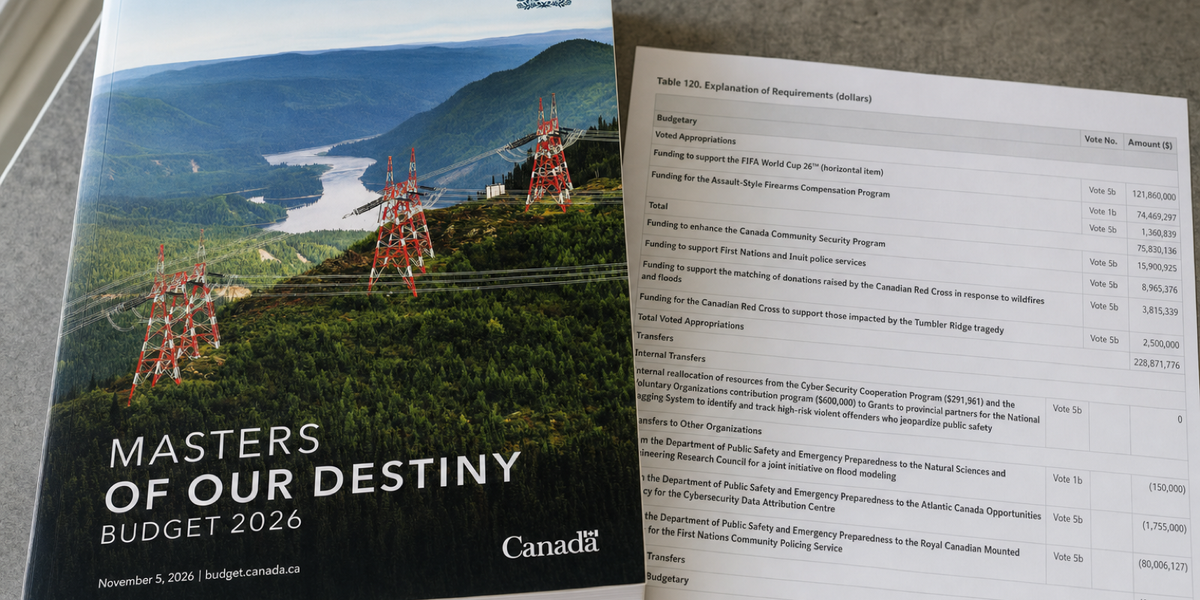
Public Safety is seeking $75.8 million for the Assault-Style Firearms Compensation Program in Supplementary Estimates (B), 2026-27. The new Estimates page carries a November 6 date, the day after Finance Minister François-Philippe Champagne released Budget 2026. Owners following the buyback's money already have another document to read.
The 532-page budget contains no named compensation-program entry in its searchable text. Searches for "firearm" and the program's full name return no matches. Its defence chapter does include Canadian Modular Assault Rifle systems among military investments. Civilian owners looking for their compensation program need the Estimates instead.
I own a Sterling Arms R9 MK1, which appears on the individual compensation list at $1,920. That gives me a practical reason to follow this file. So does the amount Ottawa is asking taxpayers to fund.
What last year's budget committed
Budget 2025 gave the program a section headed "Removing Assault-Style Firearms from our Streets." It proposed realigning earlier funding, with a net fiscal impact of $38.7 million over three years, within an existing $742 million envelope.
The table on page 199 put $364 million in 2025-26, $217 million in 2026-27, and $5 million in 2027-28. Those amounts total $586 million, with $547 million sourced from existing departmental resources. Read those columns as the profile of that budget measure. They supply no running account of compensation cheques, collection invoices, or money remaining today.
Public Safety's May 28 committee briefing used the more precise total envelope of $742.5 million. Its breakdown included about $21.8 million for program design, $28.7 million for the portal and case-management system, up to $248.6 million in compensation, and $132.2 million for RCMP collection and supporting work. Other collection and destruction costs occupy another line.
Where the money now shows up
The new Estimates put an exact amount on the next request: $75,830,136. Public Safety's explanation of requirements splits it into $74,469,297 under operating expenditures and $1,360,839 under grants and contributions. The latter amount appears in the transfer-payment table as an increase to the program's contribution line, from $29,356,265 to $30,717,104.
That split deserves attention. Nearly all this particular request falls under operations. The table supplies no further program-specific breakdown of the $74.5 million operating amount. Readers should resist turning the full $75.8 million into an estimate of compensation destined for owners, or treating the operating vote as an administrative-cost total.
The accounting can cross those categories. Public Safety’s June quarterly report recorded its ESDC compensation advance as an operating expense, pending recognition as a transfer-payment expense when expenditures occurred. The new request needs that level of explanation.
The Estimates identify spending authorities sought. Parliament must approve the voted funding before the government can spend it. The document presents proposed authorities, so these figures cannot establish completed spending or payments received.
For an owner waiting for an answer, that leaves two useful questions for Public Safety: which activities need the operating increase, and how does the request change the expected final cost? The published row gives us the amount and the vote. A departmental explanation would connect those figures to the work remaining.
Earlier this year, Supplementary Estimates (A) sought $203.2 million for the program: $41.0 million in operating funding and $162.2 million in grants and contributions. Its transfer-payment table took the business-and-individual grant line from $64.8 million to $226.5 million, with a separate contribution line of $29.4 million.
These are different views of the program's funding. Adding a fresh request to the lifetime envelope would require a reconciliation showing whether Ottawa is drawing down previously announced money, changing its timing, or increasing the total. The new row alone leaves that question open.
The government's reasonable answer
An existing program can continue without a new budget announcement. Budget 2025 said Ottawa would implement this one within its existing envelope, and the committee briefing said any surplus would return to the fiscal framework. A missing budget paragraph supplies no evidence of cancellation, a spending freeze, or the final bill.
The Estimates also have a useful purpose of their own: they show Parliament funding requirements that were insufficiently developed for the Main Estimates or changed afterward. Treasury Board explains that process. An annual budget and an in-year spending request answer different questions.
I can accept that explanation and still want a clearer account. Ottawa has required licensed owners to follow prohibitions, declarations, valuation lists, and collection arrangements. It can make the financial side easier to follow than a succession of tables spread across departments.
What has actually been paid
Public Safety's progress page, still dated June 9, reports $96.1 million paid to businesses as of June 8. Its individual-owner section gives collection information and links to declaration counts, without an individual-payment total.
Holdover has followed the $90.3 million advance to Employment and Social Development Canada and the $58.4 million batch agreement record. Those records illuminate parts of the process. An advance, an agreement value, and a settled payment each describe a different stage; none supplies the missing owner count by itself.
Public Safety's financial-report index currently lists June 30 as its latest 2026 quarter. The September 30 report is another record to watch, alongside Parliament's treatment of this new request.
One account owners could follow
I work in digital services. A system can record an application, an approval, and a payment at separate moments. Anyone designing its public reporting has to decide which stage a number describes. Owners deserve that same care here.
Public Safety should publish one quarterly financial account: the envelope and any approved changes, current-year authorities, spending by activity, advances awaiting reconciliation, settled compensation, and owners paid. Unknown or unreconciled amounts should carry that label, with the relevant reporting date beside them.
Budget 2026 leaves the civilian buyback out of its named measures. The Estimates seek $75.8 million. Ottawa now owes Canadians a clear explanation of how that request fits the money it already announced.
Follow the buyback's next public record.
The Dispatch follows Canadian firearms policy, ownership questions, and the sources behind the next development.
Sources
- Finance Canada, Budget 2026 release, November 5.
- Budget 2026, full report, searchable text and defence map.
- Budget 2025, full report, printed pages 195 and 199.
- Treasury Board, Supplementary Estimates (B), 2026-27, Public Safety Tables 120-121, page dated November 6.
- Treasury Board, Supplementary Estimates (A), 2026-27, Public Safety Tables 107-108.
- Treasury Board, Supplementary Estimates explanation and index.
- Public Safety, May 28 committee briefing, program funding envelope and breakdown.
- Public Safety, compensation-program progress, June 8 business outcomes, page dated June 9.
- Public Safety, individual compensation list, Sterling Arms International R9 MK1.
- Public Safety, June 30 quarterly report, advance accounting and footnotes 2 and 5.
- Public Safety, quarterly financial reports.
- Holdover: Steve's R9 ownership, ESDC advance, and batch agreement record.