I started handloading with *.338 Lapua*
Most people get into handloading the same way I did: by looking at what factory match ammunition costs in Canadian dollars, doing some quick arithmetic, and deciding to buy a press. The conclusion is approximately correct. It leaves out a great deal.

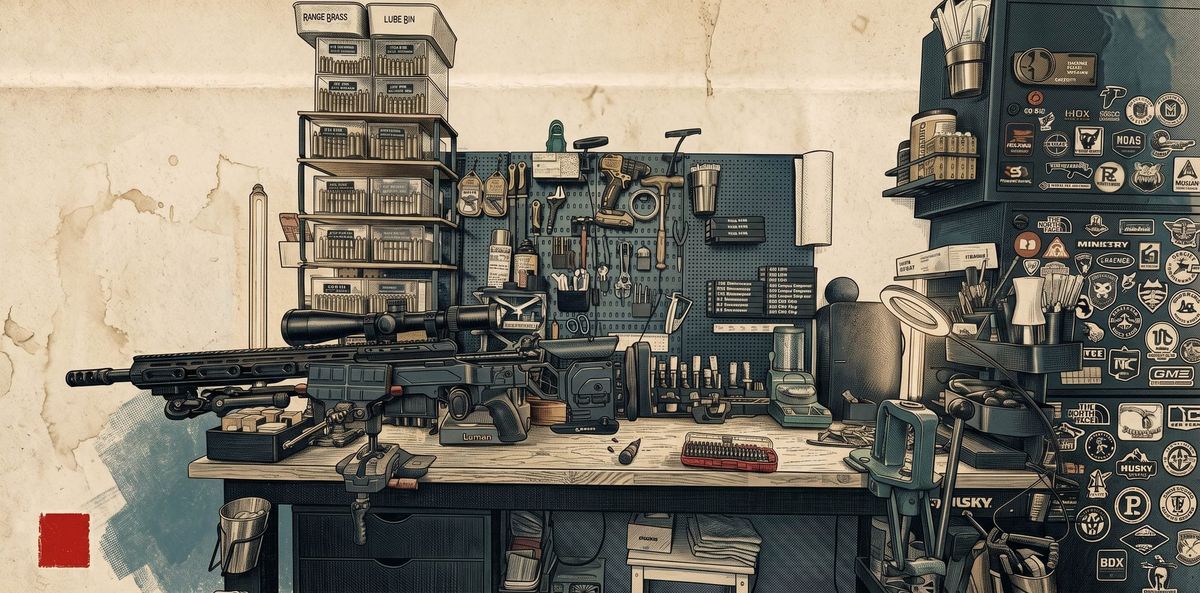
Most people who take up handloading get there the same way I did. They look at what factory match ammunition costs in Canadian dollars, run some arithmetic on how much they shoot in a given month, and decide they would rather spend the money on a press than on Hornady's quarterly margins. The press will pay for itself. That is the front half of the story.
The back half is what they learn after the press arrives.
Mine arrived in the summer of 2025. By the time I had it bolted to a workbench in my basement, I had been licensed for five months, had no real idea what I was doing, and had decided that the natural starting point for a first-time handloader was the most expensive, highest-pressure cartridge in my safe.
Reader, I do not recommend this.
The arithmetic that gets you in the door
A typical Saturday at my range runs four to five hours. I bring four or five rifles and a handgun. If I do honest accounting, which I am about to, that is roughly 250 rifle rounds across a week of practice, before we get anywhere near the pistol.
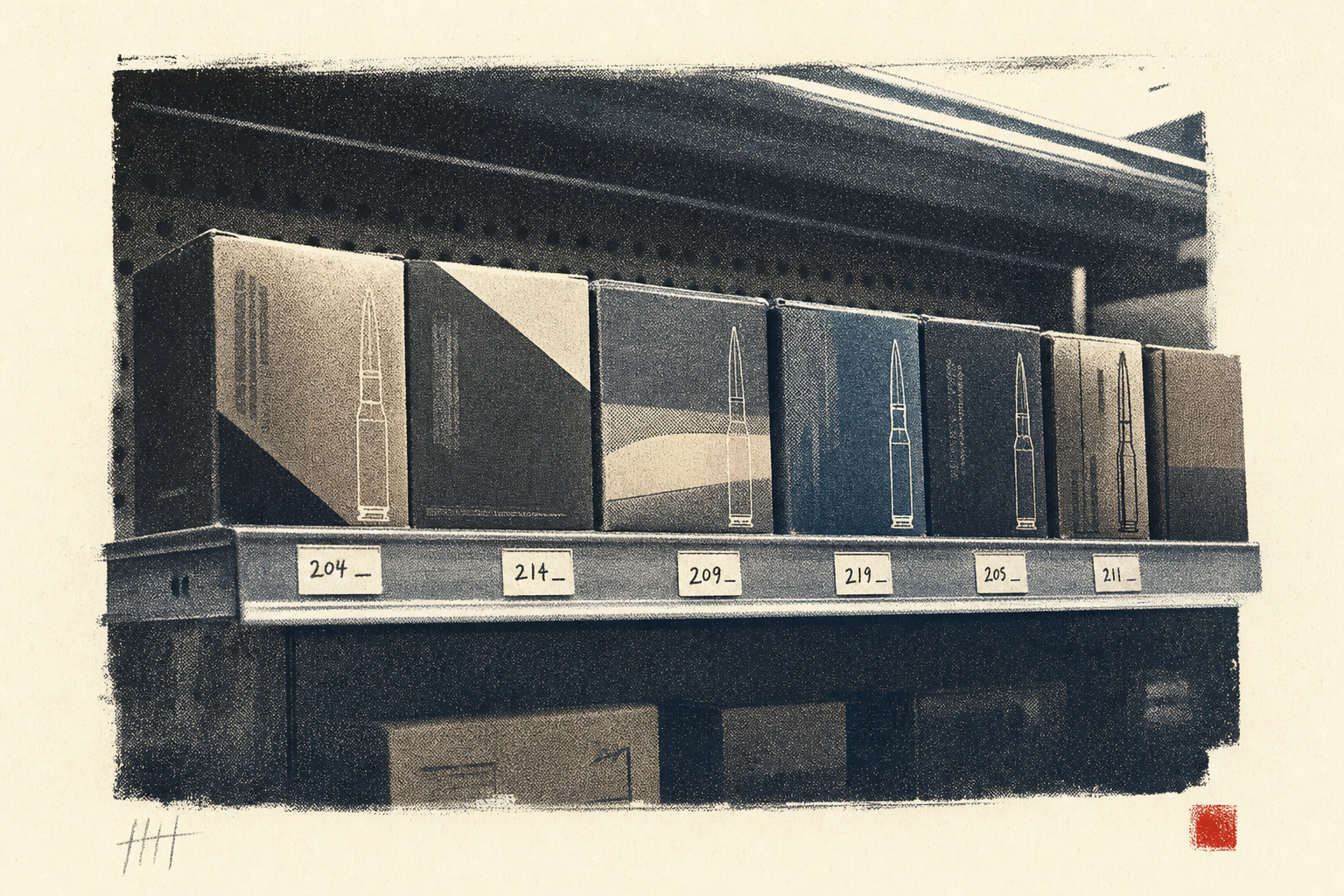
The trouble starts when you list the calibres. Currently in rotation: .308 Winchester, 7mm PRC, .300 PRC, .300 Winchester Magnum, .338 Lapua Magnum, 6mm Creedmoor, and on certain weekends a .30-06. Match-grade factory ammunition for any of those, in Canada, in 2026, runs somewhere between $80 and $200 a box of 20. The Lapua boxes I stared at on a Cabela's shelf last year were $214.99 plus tax. Twenty rounds. Roughly the price of a tank of premium fuel, converted entirely into noise and recoil in under a minute of trigger time.
The arithmetic is the first thing every prospective handloader does, and the conclusion is always the same. This is unsustainable. The press will pay for itself.
The conclusion is approximately correct. It just leaves out a great deal.
The starter kit, and other lies I told myself
I went to Cabela's. I do not recommend Cabela's as a research methodology, but in my defence I had been licensed for five months and had no idea where else to begin. The friendly counter staffer handed me the Hornady Handbook of Cartridge Reloading, eleventh edition. It is a thousand-page hardcover that, on first inspection, looks less like a reference book and more like a legal threat.
I had not opened a book of that size since I was an undergraduate, and the part of my brain responsible for learning by reading, as opposed to learning by clicking, had visibly atrophied. I took it home anyway. I am still using it.
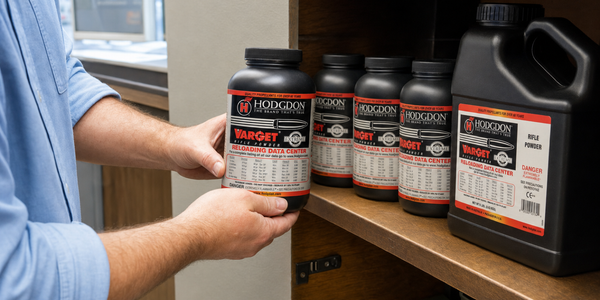
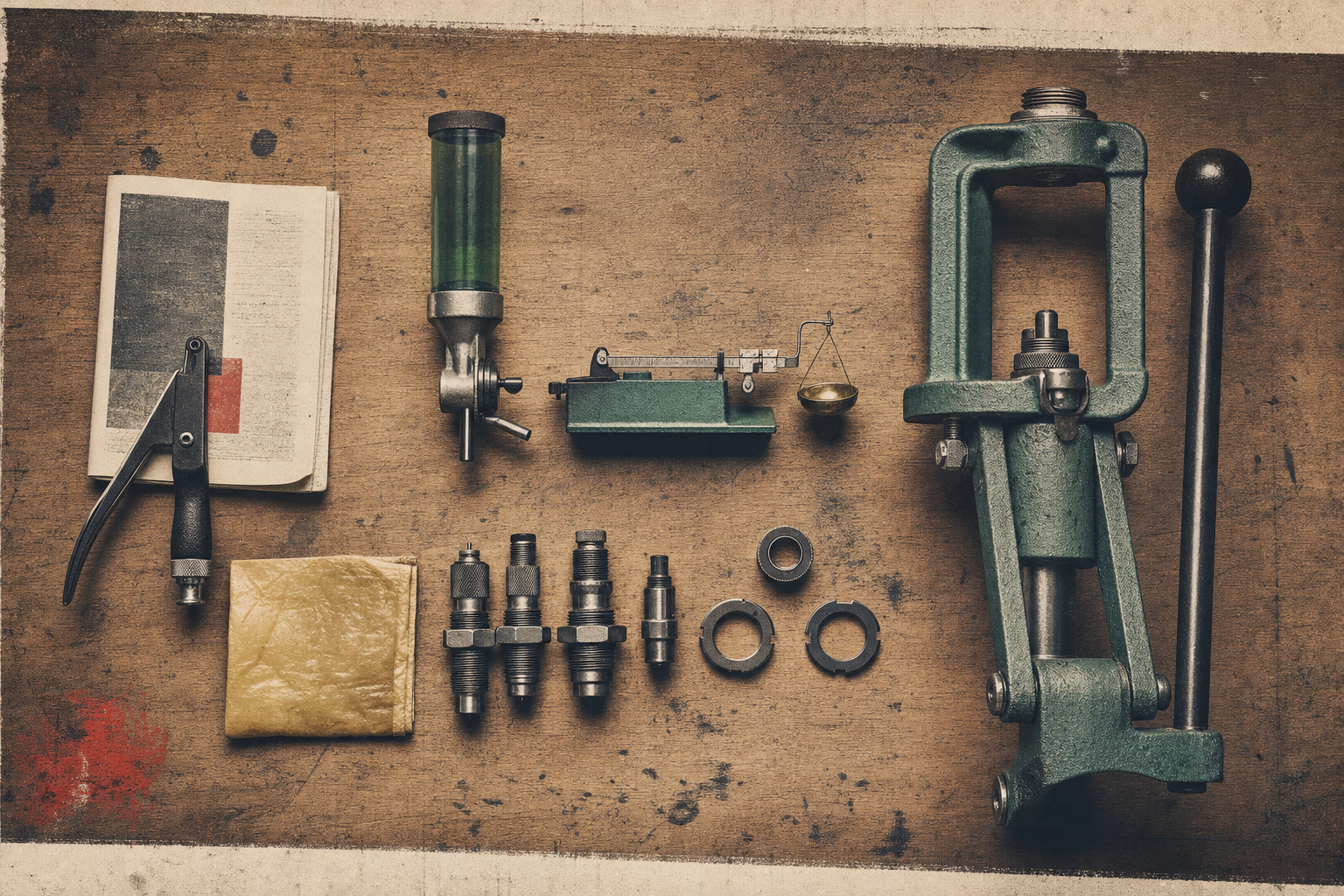
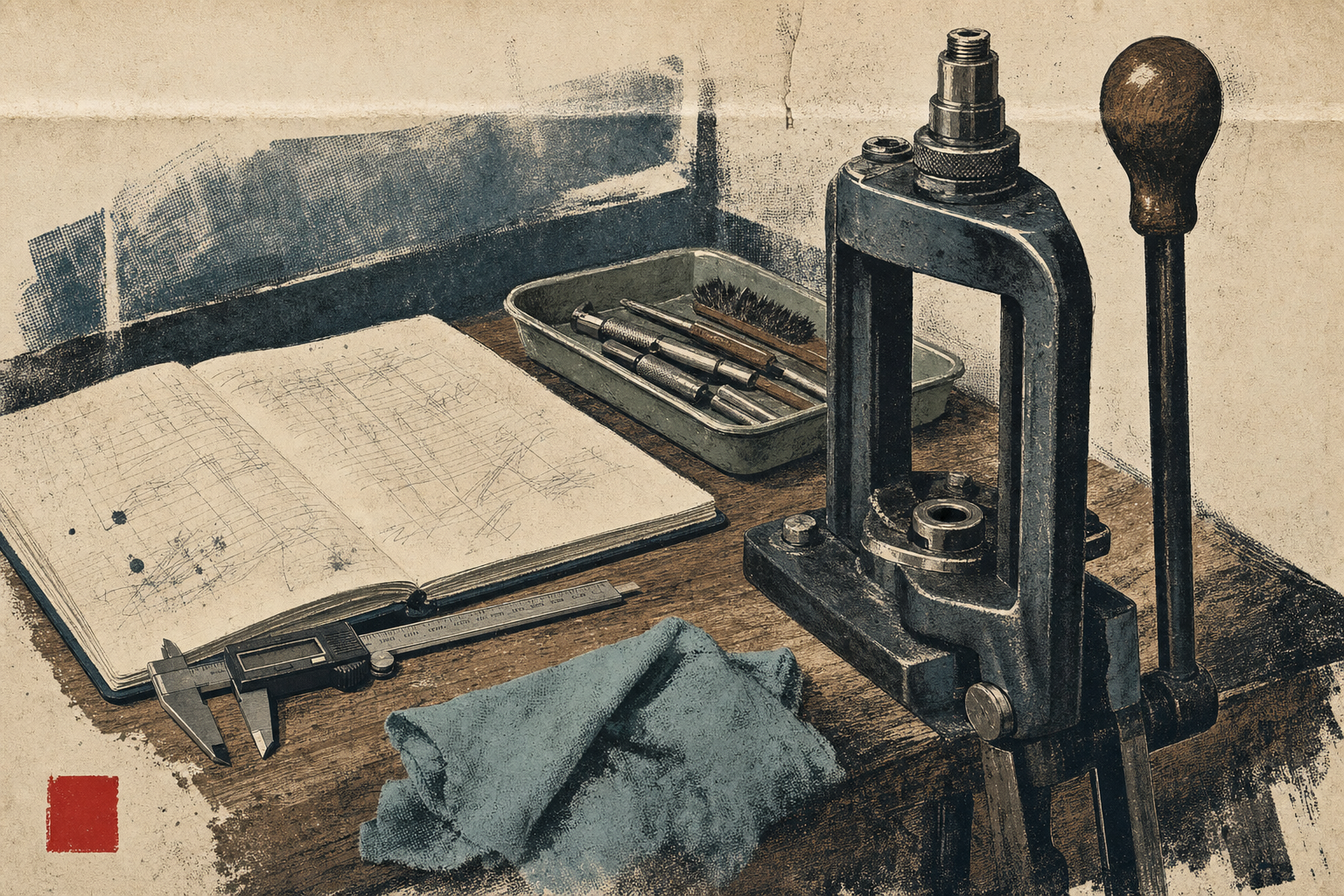
Then I bought the RCBS Rebel single-stage press starter kit. The starter kit promises to cover the bases. It does, in the same sense that an inflatable raft technically covers the bases of being a vessel. Inside the box are the press, a hand priming tool, a powder measure that is almost good enough, a beam scale that nobody actually uses past the second week, a case lube pad, a chamfer-and-debur tool, a pair of dies in whatever calibre you specified, and a paper booklet that gestures at the rest of what you will need.
What the kit does not include is the next $1,800 of equipment you will discover, one item at a time, that you also need. A wet tumbler. A dry tumbler. A case trimmer that is not a hand crank. A chronograph. A digital scale that resolves to a tenth of a grain and is not subject to barometric pressure or its own internal mood. A neck-tension mandrel set. Bullet comparators. Bushing dies. A case gauge for every calibre you load. The list does not end. It only pauses while you decide which compromise you can live with this week.
But on day one I had the kit, the book, and a stubborn conviction that I was going to save money.
The starting calibre
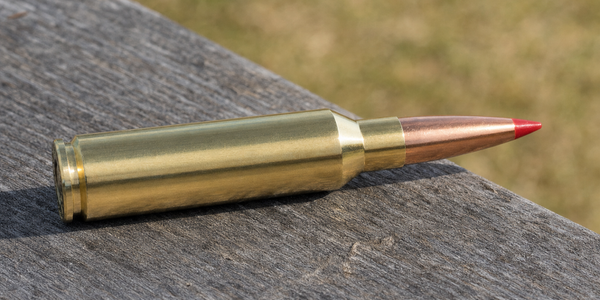
The most expensive cartridge I was shooting was .338 Lapua Magnum.
So, naturally, that is where I started.
This is the handloading equivalent of taking up baking to cut your grocery bill and choosing croissants as your first project. The economics are technically correct. The Lapua is the most expensive thing I shoot, so the per-round savings are largest. The practical sense is catastrophically wrong. Big magnum brass is the most punishing thing to work with as a first-time loader. The cases are long. The pressures are high. The dies require force. The tolerances are tight. Every mistake is expensive, in components and in equipment damage. None of this is what you want sitting in front of you when you are still learning what "shoulder bump" means.
I did not know any of this. I learned it.
What an actual first batch looked like
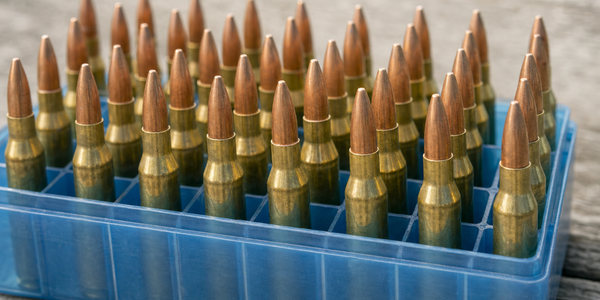
I had collected, across three or four range trips, enough once-fired Lapua brass to fill a small ice cream tub. My understanding of what came next, refined through perhaps 15 hours of online research and a series of patient conversations with one of the range safety officers at my club, was that every piece of brass needed to be:
- Washed in a wet tumbler with stainless pins, then dried for several hours
- Lubricated, evenly, with the correct product
- Resized in a full-length die, pushing the shoulder back the proper amount
- Trimmed to a specified length
- Chamfered and deburred at the case mouth, inside and out
- Primer-pocket-uniformed and primer-pocket-cleaned
- Flash-hole-deburred
- Run over a mandrel to set neck tension
- Primed
- Charged, with a powder weight measured to a tenth of a grain
- Seated, with a bullet, to a specified depth
- Measured at roughly every step, because anything you do not measure has already gone wrong
I am leaving things out. Anyone who reloads is reading that list and silently adding two or three more steps.
Whatever level of intimidation I had walking up to the bench multiplied the moment I understood what one full cycle actually looked like. I got through it. Painfully. With mistakes at almost every step.
Highlights, of which I am not proud:
- I trimmed an entire batch of beautiful Lapua brass roughly six thousandths short of any sane minimum and had to set it aside as practice brass. None of it shot.
- I broke the corner of my workbench by leaning into the press handle, trying to force a magnum case through a die I had under-lubed. The bench survived. The pride did not.
- I broke three resizing expander balls before someone explained to me, with the patience of a parent at a long airport delay, that dry neck lube exists and the reason it exists is exactly what I was doing.
- I shot the first batch at 100 yards. The groups were the diameter of a small dinner plate. I shot the second batch at 300 yards. The shots arrived at the berm in a distribution that suggested the rifle was pointed in the correct general direction.
I want to be specific about that last one. The rifle was fine. The barrel was fine. The optic was fine. I had assembled, by hand, a batch of cartridges so internally inconsistent that the rifle had no chance of grouping them. The mistakes were mine. Every one of them.
What the press has actually shown me, so far
Here is the part I would have skipped if I had read this article a year ago, and the part that turned out to matter most.
I started handloading to save money. 10 months in, I have not saved any. I have spent it. What I have actually received, in return for the spending, is a long list of things I now know exist, can name, mostly understand the shape of, and almost entirely have not mastered. The press teaches you about the depth of the hole before it teaches you anything about digging it.
A few honest examples. Each one is a thing I could not have named a year ago, am working on at the bench right now, and will be working on for the foreseeable rest of my life.
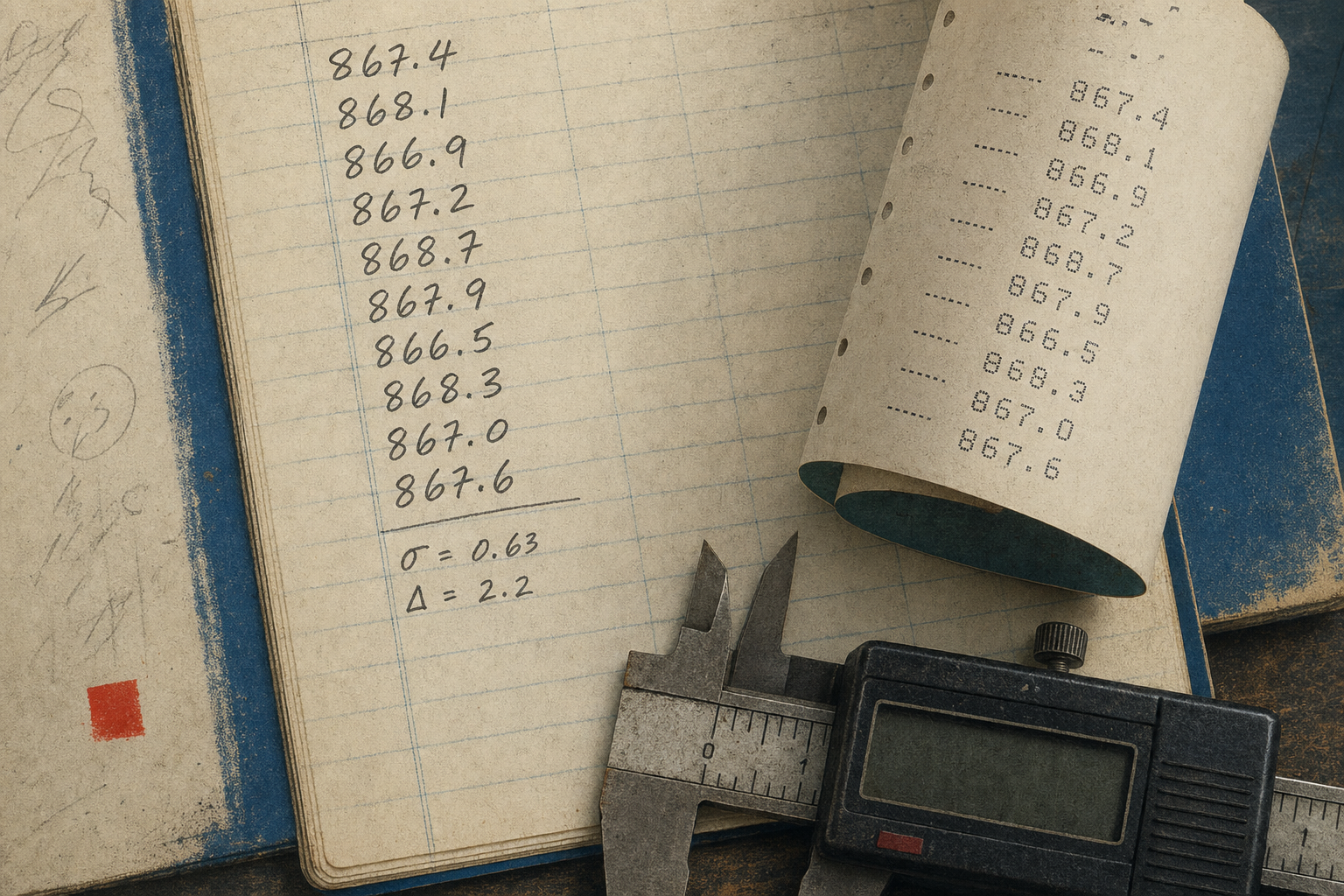
A chronograph is a diagnostic instrument. I own one. I do not really know what to do with it. I know what it measures. Muzzle velocity, standard deviation, extreme spread, all printed cleanly to a small screen at the end of every string. What I do not yet have is the practical instinct for what to do with that information at the stage of load development I am at. A single-digit SD means something. A high-twenties SD means something. Which adjustment to reach for to close the gap between the two is the kind of knowledge that lives in years of bench time, not in a manual. My chronograph, at the moment, is an instrument of polite, exact accusation. It tells me where the problem is. It declines, with great dignity, to tell me whose problem it is.
Pressure signs are how brass talks to you. My .300 Winchester Magnum has been swearing at me for months. I have had multiple case-head separations on that rifle, in some cases after only a few firings. The aftermath is unmistakable. The bright stretch ring around the base. The case body left behind in the chamber. The small dignified ceremony of clearing a partial extraction while pretending you are not concerned. What I cannot tell you, yet, is why. Whether the cause is overworking the brass at the shoulder, the chamber's headspace tolerance, the load itself, the brand of brass, or some elegantly choreographed combination of all four producing a unified symphony of failure, is the kind of question that lives at the intersection of about six different rabbit holes. I am currently in one of them. Almost certainly the wrong one.
Annealing extends brass life. By how much, I genuinely could not tell you. I anneal after every firing now. I understand the principle well enough to explain it at a party that, in retrospect, has gone wrong. Heat cycles restore the work-hardening lost from sizing. The neck stays consistent through more cycles. The case lasts longer. What I do not yet know, with any kind of precision, is how much longer. Three firings? Eight? 15? More importantly, what does a piece of brass actually look like at the end of its useful life, beyond the obvious split neck? Loose primer pocket? Stretched body at the web? Some quieter signal I have not yet learned to read? These are the questions I am asking the older shooters at my range now. Their answers reliably begin with "well, it depends" and end with "you'll know it when you see it," which is not the level of specificity I had hoped for.
Neck tension is real, and tunable. I am using mandrels. I have no idea how much they are doing. A year ago I had no concept that the interference fit between bullet and case neck was a variable I could adjust. Now I have a set of mandrels in 0.001-inch increments and a routine for using them. Whether the routine is producing measurably better ammunition, or whether I am performing a handloader's superstition with steel and lanolin, is something I genuinely cannot tell you. Every handloader I ask about neck tension has a slightly different answer, delivered with a confidence that is inversely proportional to the evidence they cite. The next move is to measure seating force in actual numbers, compare strings at deliberately different tensions on the chronograph, and start to separate the adjustments that do real work from the ones I am doing because someone on a forum told me to.
Charge weight nodes and barrel harmonics are real. I have not really found one yet. I have run ladder tests. I have nodded thoughtfully at the chronograph output. I have squinted at clusters of impacts on paper and decided, with the calm authority of someone who has read three articles, that one of them was the node. Whether those decisions were correct, or whether I was reading constellations into the noise of an under-resolved test, is something I will not be able to answer with any confidence until I have done it many more times. The first time you walk a ladder, the data looks like a constellation chart for a sky you have not seen before. By the fifth or sixth, the patterns start to suggest themselves. I am on test three.
The honest summary is that 10 months at the press has not given me a working command of any of these. It has given me their names, their general shape, and a clear, slightly humbling sense of what I do not yet know. My groups are tightening. The chronograph numbers are creeping the right direction. Something is working at the bench. But every problem I solve appears to surface three more I had not previously noticed, and the depth of the next layer is never quite visible from the top of the current one.
This is the part nobody warns you about, and the part I have come to like the most. Handloading is oddly frustrating and oddly satisfying in the same motion. Each fix is the start of another investigation. Each discovery is a longer list of things to learn. The rabbit hole does not end. It branches, repeatedly, into smaller and more specific rabbit holes, each with its own small population of people willing to argue about it on the internet for free.
I came to this hobby thinking it was a craft I would learn. I now suspect it is a craft I will be learning indefinitely. That is a worse pitch on the page, and a better one on the bench.
The honest accounting
I want to close where I started, with arithmetic, because I think it is the only fair way to give anyone considering this an accurate picture.
A year in, I have replaced or upgraded most of what came in the original starter kit. Some of it twice. Some three times. The original powder measure is in a drawer. The original beam scale is in a drawer. The original case trimmer is in a drawer. The original case lube pad sits beside a bottle of liquid lanolin that does the same job in a tenth of the time.
The current bench is a different operation. A wet tumbler. A dry tumbler. An annealing machine. A digital scale that resolves to 0.02 grains. A powder trickler. A Henderson trimmer. A Forster Co-Ax press in addition to the original RCBS. Dies of varying lineage for seven calibres. A chronograph that mounts to the rifle's rail. At least three measuring instruments per calibre.
I have not done the full sum. I am also not going to.
The time accounting is its own story. Working from home means I drift between my desk job and my bench job over the course of a day. Over a week that runs five to seven calibres, I am putting in 8 to 10 hours at the bench. Some of it is enjoyable. Some of it is meditative. Some of it is yard work. All of it is real time, and none of it shows up in the cost-per-round number that got me into this in the first place.
Even if you cut corners, even if you load for one calibre, the temptation to walk into Cabela's and grab a box of factory ammunition stays high. There are weekends where the time math is brutal and a box of Hornady on the shelf reads as an act of self-care.
Why I do not regret any of it
If you are reading this because you are considering handloading, I do not want to talk you out of it. I am still in, completely, and the lessons it forces on you are worth more than the components.
But take this from someone less than a year in who is still finding pieces of his original kit he wishes he had bought differently. Handloading is not a hobby you start. It is a hobby you commit to. Buy less than you think you need at first. Start with the smallest, cheapest calibre you shoot, not the most expensive. Find a mentor at your range; the older shooters around the bench at any decent club will save you years. Be willing to throw out batches. Be willing to be wrong. Measure everything, twice, before you decide it is the rifle's fault.
Or do what I did, and start with .338 Lapua.
It is, in its way, a complete education.
Related Holdover Tools
Useful calculators and references from the same corner of the Holdover bench.
- Holdover tools
- Reloading Cost Calculator
- Reloading Starter Kit Builder
- Load Development Plotter
- Target Analyzer
- scope click calculator
- Bullet Drop Visualizer
- Recoil Comparison Tool
Sources
- Hornady Handbook of Cartridge Reloading, 11th edition, Hornady Manufacturing.
- RCBS product documentation, Rebel single-stage press and Rebel Master Reloading Kit.
- Author's own load notebooks and chronograph data, 2025-2026. Sample sizes referenced inline.
Keep the range trip from becoming a guess.
If this piece has you thinking about actual load work, keep the range data tidy before you start comparing groups.
Use the Holdover Load Development Worksheet to record charge, velocity, group size, pressure signs, weather, and the repeat-test plan before you enter the data in the Load Development Plotter.
Safety note: the worksheet does not provide load data or recommend charge weights. Start from current published manuals and work carefully.
Get the worksheet through The Dispatch
Source trail refreshed
This article was refreshed for accessibility and source discovery on 2026-05-21. The opinion has not been rewritten; this block keeps the source trail easier to inspect.
Primary source trail
- Hornady 11th Edition Handbook product page
- RCBS Rebel Reloading Press manual
- RCBS reloading kits product page
- Prairie Gun Traders ammunition price-list PDF
- Hornady 2025 product catalog